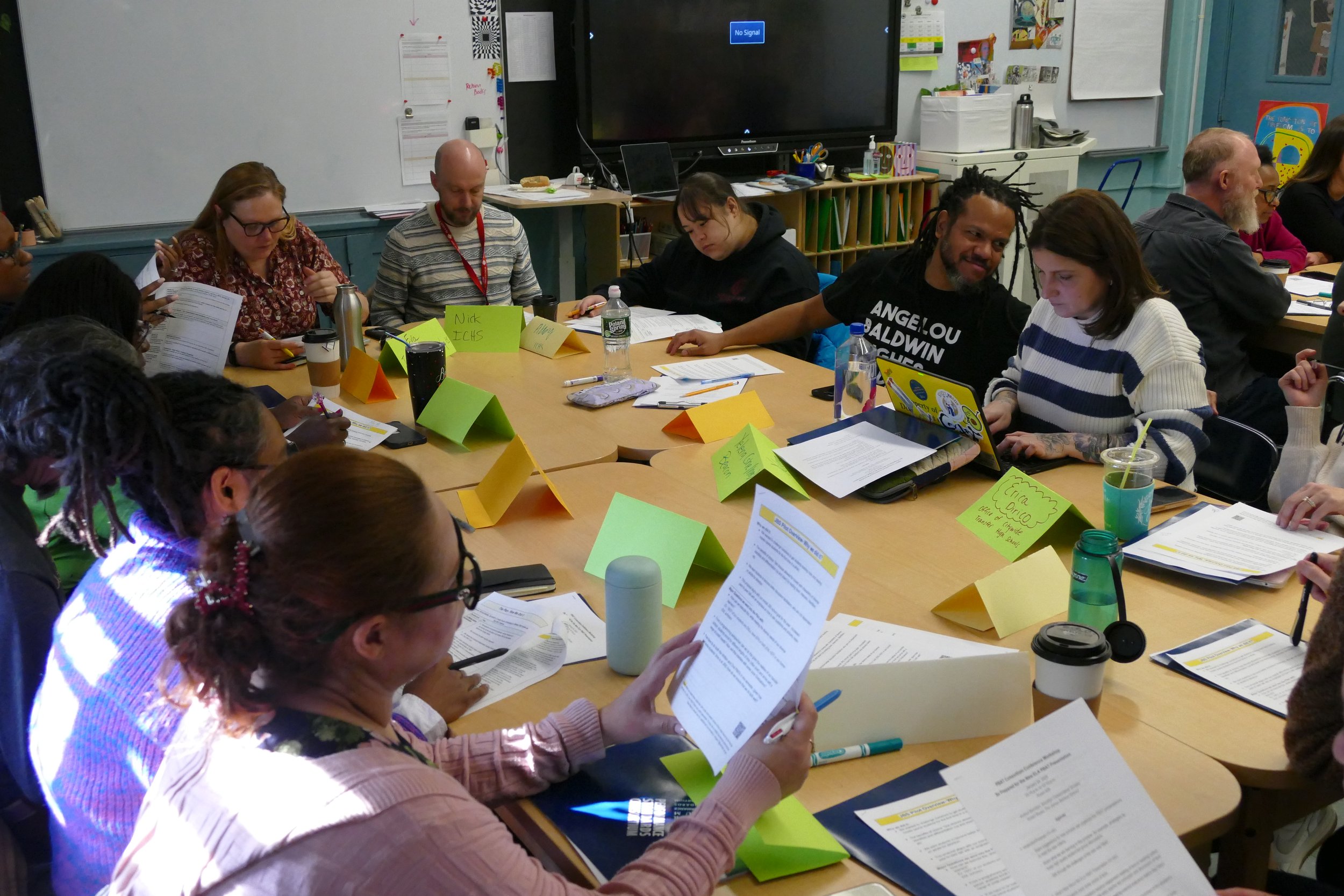
Twice a year, teachers from every Consortium school score the same student work and teacher assignments against shared rubrics, without seeing the original school's scores, then examine where and why their judgments differ.
Consortium students graduate by completing four performance-based assessment tasks (PBATs), designed by teachers, scored against common rubrics, and defended orally before external evaluators. A shared rubric is a starting point, but teachers can read it differently, and a teacher who knows a student well may read generously.
Moderation studies are focused on answering two questions: Are teachers' tasks rigorous enough for graduation-level work? Is student work scored consistently across the network? They are also one of the main ways the network builds teachers' skill at designing and assessing performance tasks.
How it works
Schools submit tasks and student work. Each year, schools submit teachers’ PBAT assignments and student papers written in response. A rotating sample of schools is then selected for moderation.
Task is examined. In subject groups of 10 to 12 drawn from across the network, teachers examine the assignment for alignment with Webb's Depth of Knowledge (DOK) and the subject-specific rubric.
Teachers rate student work independently. Following the evaluation of the task, teachers rate the student paper on each rubric criterion, with an overall rating from Outstanding to Needs Revision.
Groups weigh the evidence. Teachers explain them with specific evidence from the paper and focus on the criteria where they disagree most. Independent ratings are recorded before the discussion. Minority views are heard, and teachers can then revise their ratings.
Feedback goes to schools. The school receives written feedback on its assignment and the moderated rating for the student paper to compare with its own. Network staff follow up to support schools whose tasks lack alignment to higher levels of DOK and/or the rubric; whose student work is moderated two or more levels above the school's rating; or if the work is rated Needs Revision by the moderation panel but passing by the school.
Accountability & Capacity Building
Moderation studies do two jobs. First, they hold each school's work to the network standard, and, second, they help teachers design better tasks and score more consistently:
Schools learn whether their assignments are demanding enough and whether their scoring matches the network's.
Teachers read student papers from other schools and debate evidence with colleagues in their discipline, taking sharper criteria and new assignment ideas back to their own classrooms.
Every school participates, and open committees of Consortium teachers write and revise the rubrics. What surfaces in moderation feeds those revisions.
For Policy and Policymakers
In September 2026, the New York State Board of Regents voted to end the Regents exam requirement for graduation, beginning with the class of 2028. Every district in New York State now faces the same question the Consortium has answered for more than 25 years: how do we ensure schools are holding all students to high expectations?
The Consortium’s approach to assessment and accountability shows that comparability — whether results from different conditions can support the same inferences about what students know and can do — doesn't require identical tests. Consortium students don't write the same essay, but every passing PBAT should support the same conclusion: this student has done independent, graduation-level work in the discipline. Moderation is one way that is checked.
In the Consortium, rubrics are the common standard, teacher-designed tasks reflect curriculum and the context of each school, and moderation ties the two together. Broader evidence of learning raises, rather than removes, the obligation to show it is valid.
Thirty years of test-based accountability has produced compliance more than trust. Community trust should be the first principle around which school accountability systems are designed. Rather than compelling people to believe in about top-down measures, trust grows when there is a clear and rigorous common standard and the people closest to students have a real role in defining and assessing quality.
To learn more about the Consortium's moderation process, contact AJ Rathmann-Noonan (aj@performanceassessment.org).
For the broader case for rethinking accountability, see eduaccountability.org.